Chicago Literary Hall of Fame Inductees
Jean Baptiste Point du Sable built a farm at the mouth of the Chicago River in the 1780s, and every moment since has been filled with the shrieks of a city being made and remade, shaped and shifted, expanded and gutted, painted and stripped. Strangers descended upon Chicago then and now. Some came and went; some came and went and came back again; some stayed and stayed and stayed. Chicagoans worked. Honest toil, a lot of it. Criminal work, too much of it. Those Chicagoans who weren’t coming to each other’s aid or bending toward one another—those who weren’t working for the common good—were taking advantage of the weakest and least suspecting. From the ranks of politicians and police officers, builders and business tycoons, shop keepers and shoe salesmen, come our greatest heroes—and villains. Often, it’s hard to tell where hero ends and villain begins.
City life happens at such breakneck speed that there is almost no time to process, much less reflect upon, what is happening to whom, and why. But that is our writers’ work. To explore. To reflect. To record. To question. To move emotionally and to move intellectually. To help us, the readers, make sense of life, or at least process it from different points of view and through different voices. To allow us to infiltrate the vast geography of a city: the soil, the water, the cement, the art. The people.
From Chicago’s earliest times, as early as 1872 when a New York chaplain wrote a novel about the Great Chicago Fire, Chicago has nurtured great literature while simultaneously being a perpetual subject of it. Chicago’s literary heritage is on par with the greatest in the world: Dublin, London, Paris, New York, Boston. Chicago’s literary greatness starts with its determination to support and consume literature of all kinds, from poetry to journalism to novels to comics to short stories to essays. It continues with a perpetual influx—through migration and birth—of writers willing to take seriously the task of creation. It continues still through the kind of character—from Chicago’s transportation system to its natural beauty to its cultural exquisiteness to its educational systems to the price of tacos—that enables and inspires fledgling artists to bunker down to difficult, largely unprofitable work. It flourishes with an elite group of artists whose literary output is of such immense importance and sophistication and quality that their stories will, or should, endure and benefit generations to come.
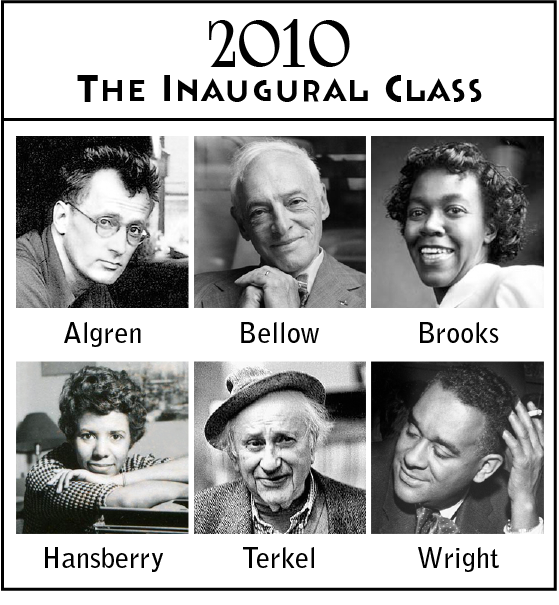
It is these elite writers who have been and will continue to be honored through induction into the Chicago Literary Hall of Fame. Starting with the Inaugural Class of 2010, the CLHOF has annually inducted six literary figures. These writers, all dead, share only a few common characteristics. Chicago was vital to each of their careers—whether they arrived a stranger, were born within these borders, or were here then gone, these writers would not have been the same without Chicago, nor Chicago without them. Their literary output, judged on any merit, made timeless and important contributions to art, to society, to our city, and to its people.
Our inductees, some of them, are household names—they’ve had postage stamps made in their likeness, streets named after them, schools and cultural centers and libraries dedicated to them. That is not the criteria upon which these writers gained induction, but a deserving byproduct of their work. Other inductees, perhaps known and celebrated in their time, rescinded from the public consciousness, to the point where even the most diligent readers don’t bother with them anymore. Some inductees never established a popular reputation, though all certainly gained admiration and respect from writers, critics and otherwise engaged cultures.
Choosing and curating a Chicago Literary Hall of Fame is a way to honor not only our literary past, but our past, period. It is a demonstration of pride in our literary heritage, and a statement of its importance to our lives. It is a way to keep our best literature alive and relevant.
2010 Induction Ceremony described in the Chicago Tribune